Thursday, February 5, 2015

Einstein and Music

Yesterday I was reading a book on Einstein's life by Swami Tathagathanada of Vedanta Society of New York. I was pleasantly surprised to know that the great physicist was also a musician and a very talented one . At the age of 5 music was Einstein's inner necessity. Not only did he play beautiful works of Mozart , Bach and Schubert but also improvised them. 

    Einstein's friend Paul Plaut mentioned in 1928 that  Dr Einstein would often play his violin late in the night improvising melodies while he thought over complicated problems. As he got his answer in the middle of playing , he would shout excitedly "I've got it". It seemed as if somehow the solution of his problem came through music. 

We know very well that Einstein devoted his entire life to Physics but what we don't know is the other thing to which Einstein had devoted his life was music. He never discussed music with others but simply said listen, play , love , revere and keep your mouth shut. 

It also states that Einstein found some harmony between physics and music. Maybe it something that's worth doing some research on if music can indeed make the mind work better. 

Wednesday, February 4, 2015

India - Education, Economy

When Swami Vivekananda was alive ie in 1901 a population census of India was done by the then colonial government. Back then the Literacy rate among Indians was a meare 5.35% , male literacy was 9.83% and shockingly female literacy was a mere 0.6%. Such a nation was bound to be a slave since without education man is nothing but an animal. 

One more fact is that this figures are for literacy. Now literacy is not education. Education is a relatively long process. Being able to read and write was just the begining. By 1941 the literacy rates had risen to 16.10%. Female literacy in 1941 was 7.3% a growth of 1200% over 1941 and male literacy was 24.9% a growth of 270% over 1901. This probably explains why we got indepence in 1947 more educated people around. 


So in 40 years India's literacy increased by 300% and what happened after that which included 33 years of Indian Independence. In 1981 the percentage of literates had gone up from 16.1% to a mere 36.23%.One more thing that is noticeable is that the growth in literacy of India between 1941 to 1951 was very small from 16.1% to 16.67%. So in 40 years the growth in literacy was a mere 125%. Compare that to South Korea in 1945 its literacy rate was 22% which increased to 87.6% in 1970 and by the 1980s its literacy went up to 93%. This shows that the Indian government made very little effort to increase the spread of education in the first 40 years. This explains why South Korea developed so fast and India lagged behind. 


Since Indian Independence the government consisted of people who were not interested in the well being of the nation. They hardly did anything to stop the rapid population growth. Even today each year we are adding an Australia to our population. While South Korea is actually has a birthrate that would reduce its population. The South Koreans are economically prosperous. They became independent much after India . South Korea was a very poor nation when it became Independent but withing a few decades it grew into a very prosperous nation. 


Some of the biggest companies from the world are from South Korea. Although it did have a quite a rough political history but South Korea went through decades of very rapid economic growth and today its per-capita income is more than $35,000. South Korea has one of the most densely packed population in the world it has a population density of 472 people per square kilometer. 


Same is the story of Israel . Countries like South Korea , Israel became independent much latter but today are way ahead of India in economic and technological achievements. India has lot of catching up to do and for that people have to vote for correct people who work honestly for the people. The sooner people realize this in India the better it is.


Friday, January 30, 2015

Internet and India

India now has approximately 300 million Internet users. More than 65% of the Internet users are from cities which have around 31% of the country's population and around 35% of the Internet users are from the rural side. However 69% of India's population lives in villages so the need of the hour is that the rural Internet penetration must also go up and it will go up.

     One great advantage that India has is that today there are more than 800 million active mobile phone connections. In India one can access the Internet and do some basic browsing at a mere Rs 2 to begin with. The growth in the number of Internet users across the country will boost e-commerce. This is sector that is bound bumper growth in the coming years. By the end of 2015 it is very likely that India's Internet users base will be between 360 -400 million. India has now displaced USA from second spot in terms of number of Internet users.


      As Internet penetration goes up more and more people will have greater access to information can buy and sell stuff online and it will become a great tool for learning as well. Looking into the future one can foresee a time when many of the rural folks of India will actually attend collage from their home by enrolling in one of the free online MOOCS or simply studying online. One can easily watch videos of lectures and also see practical demonstration of various concepts. 


    Its very much possible instead of going to the market farmers of India may directly sell their products to the consumers thus earning more. A higher earning farmer gets into a virtuous cycle of well being. It works this way --- When a farmer earns more he would spend more on education , technology and health of his family. This would result in a more educated , knowledgeable and healthy farmer who will go on to increase his production per acre thus making more money and the extra money is invested back in agriculture. 


    Most farmers in India are poor at the moment as their incomes go up even they would consume more so the market would expand thus demand of farm products will go up. 


    Access to Internet will make sure that they don't have to travel large distances to get their work done and they will be abreast with the latest happenings across the world. Just like mobile phone has revolutionised the communication system in the nation. Internet is bound to have a deeper impact among the masses.

Thursday, January 1, 2015

Innovation and Development

A spark of innovation can destroy systems built over thousands of  years. Innovation can change lives. When man figured out how fire can be used it was a game changer for him. He was now no longer afraid of dark because fire provided him light in the dark. He was healthier since he learnt to cook the food in that fire and eat it. Also frequent heating of the meat helped him to preserve the meat for longer periods of time. Fire became his weapon and his protector since wild animals were afraid of fire. The smoke that he got from partial burning for firewood helped him to keep harmful flies like mosquitoes away. He used fire to make stones hot and give them shape that would make them sharper and hence more lethal. 

     A simple innovation Fire which man started using either by observing nature ie Forest fires that happened when two trees rubbed vigorously across each other and copying the same (as we see it among American Indians and Australian aboriginals) or by chance stumbling on two flint stone pieces rubbing each against the other  generated a spark powerful enough to ignite dry grass or saw dust. 


Thus the first innovation of man FIRE made him the undisputed King of the Jungle a class above other animals. 


So we see that at the very basis of human evolution innovation has played a very important role. Without innovative thinking man won't have come up so far. Human innovation did not stop there but continued and accelerated.


   The next big innovation was wheel. The wheel enabled humans to build carts that made transportation easy and fast. This innovation was so big that even today most of physical inventions made by man is directly or indirectly someway somehow linked to the wheel. The tyres of your cycle, motorcycle, car are wheels . The same principle of wheel is responsible for the working of various machines . The hard disk or the DVD drive of your computer uses the same principle of wheel to rotate. The turbine is a wheel whose rotation generates electricity.  In short the innovation of wheel resulted in tremendous development in the fields of tools and machinery. The wheel played a major role in the material development of man. 


Similar has been the story of many other innovations that happened through the course of human history. Different innovations have had varying degrees of impact. Some changed the world some had very little effect but innovation is essential because humans are always cornered with challenges and humans have to overcome them through innovative thinking. 


Not just challenges but many a times simply following his curiosity man stumbles on various materials studies them their properties and once having grasped this knowledge, man smartly creates products and services that would change they way he lives. 


   It doesn't stop there once a product is first invented it goes through a series of subsequent improvements take for example the hard disk. The first hard disk was of the size of two refrigerators used to consume huge amounts of power and provided a storage of mere 3.75 Mb(megabytes). The cost per megabyte came to around $ 9200. However subsequent improvement in the design of hard drives have made it smaller and smaller. Today you have hard disk that are less than 1 inch in size consume a mere 2 watts of power and a standard 3.5 inch desktop hard disk can store up to 10 Terabytes of data(3 million times more than the first hard disk). The cost per megabyte of storage is little as $ 0.000035 or 3.5 cents per gigabyte. This has been made possible by constant improvements in the design of the hard disk. The basic principle is the same but researchers figured out how to put more data in a square inch of the drive. In the future hard disks will have even higher capacities. 


The development of a nation today depends on scientific and technological work that happens in that country. The modern day examples today are to name a few South Korea, Japan, Israel. Japan and Israel are particularly lacking in terms of natural resources but still they achieved great economic progress thanks to their technological achievements. The are other nations like Saudi Arabia, UAE , Qatar which are rich. But this countries are oil rich and the money make by selling oil is ultimately invested in building infrastructure. The infrastructure is built by companies of countries that are advanced in technology.  Without the technological advancement of western and far eastern countries the Middle East countries would have remained poor since the oil would have been of no use. In fact they couldn't have dug out the oil at all. 


The real wealth of a nation is in the minds of its people. Through good education the young minds need to be nurtured into becoming excellent people and excellent innovators of the future. 


Tuesday, December 30, 2014

Investigating Life(UNIVERSE and Earth) - 1

Lets go back in time say about 300 years ago in 1714. Till now you don't have electricity, hardly any machinery, steam engine is not there and the fastest mode of transport that you have is the horse. For cooking you depend on wood. A person has no chance to communicate instantaneously with a person who is more than 200 meters away. 

 Now imagine a person from that time suddenly falls into a space time wormhole and comes to the year 2014 and what does he see cars, roads , lights , planes and he sees people being able to communicate with anyone who is located anywhere in the world or even in space. Flying was considered impossible for humans in his time but humans not only flew like birds but flew way better than birds . So much better that they crossed the boundaries of the atmosphere and even crossed the boundaries of earth's gravitation. The person would be astounded to see how much development humans have made in science and technology in a short period of 300 years.

Now imagine an alien race that was at our stage of evolution a million years ago , if in 300 years there can be so much development how much more development can be achieved in a period of a million years. The results ca be unthinkable. We may find stuff that would be way beyond our imagination. 

Now consider this NASA's Kepler mission observes planets around 125000 that have earth like conditions. Can similarly a highly advanced alien race be keeping a strong watch over us. They maybe observing us at the moment they may know what I and you are talking about. They may even have the power to influence you and me . Maybe their technology is so developed that they can take form of any human being and talk to others. 

Some of them may have already visited the earth by making a show of having being born from a human mother. They might have taught us , they might have been with us and some of them may even be reading this article as I type it down. 

The ancient man when he saw people with such very highly advanced technologies might have mistaken him to be the creator and might have called him God. So it is very much possible that what we call god , the different avataars like Shiva,Vishnu, Krishna, Ram, Mohommad, Jesus and all other gods from various cultures across the globe are no one else but this highly advanced creatures who came to influence and help in our development and evolution.

What was technology back then would have been interpreted as a miracle. For example :- The Chakra of Krishna or the Bramhastra of Bramha were highly advanced weapons capable of controlled destruction on a large scale , the technology was so advanced that the ancient man simply interpreted it as miracle or magic. They called it divine. 

This alien species might have had technology to read the thoughts of people. Already scientists today are working on technology to read thoughts but it is possible that our advanced alien race might have perfected this technology hundreds and thousands of years ago. When people were told about their thoughts they regarded this ancient aliens as gods. They called him the almighty capable of doing anything and everything and started worshipping him as gods created temples, churches, stupas , mosques etc.

Considering the universe as we know it alien life is a possiblity and it is also possible that such advanced aliens may exist or might have existed earlier. As compared to the Universe the earth by size is infinitesimally small entity.


Wednesday, December 24, 2014

An Invention that would make microscope an household item

It is believed that life started on earth when various biochemicals came together and formed the first micro-organism which is believed to be the amoeba. This life form constantly evolved into complex organisms birds, dinosaurs, various mammals and ultimately humans. Humans by their advanced, constantly evolving and improving brains invented the microscope to understand the microscopic world. To know about the various cells that constitute the human body, how do the microorganisms look like , to know how does finer particles of matter  look like. 


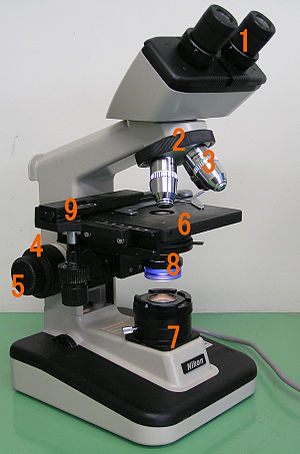
Optical Microscope

  • Eyepiece (ocular lens) (1)
  • Objective turret, revolver, or revolving nose piece (to hold multiple objective lenses) (2)
  • Objective lenses (3)
  • Focus knobs (to move the stage)
    • Coarse adjustment (4)
    • Fine adjustment (5)
  • Stage (to hold the specimen) (6)
  • Light source (a light or a mirror) (7)
  • Diaphragm and condenser (8)
  • Mechanical stage (9)
   The optical microscope has been in use for a long time and there has been hardly any change to its design. However more advanced microscopes like electron microscopes did come into existence and provided great magnification. But for the sake of detection of diseases - to observe the microorganisms that causes the diseases an optical microscope is normally enough. 

Now the problem we have this microscope is , its bulky and expensive and it is not easy to carry around. Thus except for research institutes, scientists , laboratories  and educational institutions very few people use microscopes. 

Manu Prakash , Assistant Professor at School of Medicine at Stanford University along with his students have come out with a new kind of microscope named "Foldscope". It is essentially made of stout paper that needs to be folded and then it can be used as a projection microscope. As shown in the below video which is Manu Prakash's speech at the a TED event in  he describes the Foldscope.


This foldscope can make microscope a common item at home just like we have the thermometer or the mobile phone. The inventors of Foldscope want to make it as common as a pencil , Manu Prakash says "The vision we are pursuing is to make a microscope akin to a "pencil" - wherever you have a pencil, you should have a microscope". It will surely boost children's curiosity towards exploring the microscopic world. It is very very light , very easy to carry , waterproof and extremely sturdy. Last but not the least the most attractive feature of this new invention is that it will cost not more than $ 1 or in India terms less than Rs 65.

        I just hope that I can get hands on one of these very soon would love to have one and explore the microscopic world. Watch magnified samples of my skin, blood, saliva, semen ;)  and everything microscopic I find around me. I will upload all the pics on this blog and on my Facebook pages. Simple people investigating the microscopic aspect of nature ... how wonderful that would be. 

      I am absolutely sure that around the world there would be millions of people who would do the same and in fact observing microscopic world would become a pastime for many (the numbers will be in millions). When kids are introduced to such gadgets from childhood many of them would be inspired to turn into scientists of the future. That's how cool and wonderful this invention is. 

  For all of you who are  interested to be a beta tester for the foldscope project they can register at www.foldscope.com/beta-signup

Tuesday, December 16, 2014

Tannenbaum- Trovalds debate (David slaying the Goliath)

    A few days ago while translating a Wikipedia article to Hindi I stumbled on the Tannenbaum - Trovalds debate that happened almost 23 years ago. The GNU operating system was almost ready but it lacked one major component --Kernal. Stallman went for a multiserver microkernal called Hurd. However after so many years even today the Hurd is not ready for commercial deployment. A young university student named Linus Trovalds started a project to build a kernal for for the GNU OS. It was a hobby for him , just a part of his learning. By 1992 Linus successfully build a Monolithic Kernal( with the help of other programmers who co-ordinated over the internet)for the GNU OS .   

    Now Andrew Tannenbaum the renowned OS researcher and professor, who has written books that every computer science student has read at least once, made this post in comp.os.minix the title of post was "Linux is obsolete" . Tannenbaum argued that making a monolithic kernel in 1992 was taking a giant step backwards towards the 1970s. He also argued that the kernel was too strongly connected to the x86 processors which will be history in some time and that in some time the x86 line of processors would be superseded by other processors.


   As it turned out we now know that Tannenbaum was  totally wrong. Even today we use the Kernal designed by Linus Trovalds, of course many others wrote code for it. To this day most computers and servers run on x86 processors of course with time we have moved to the 64 bit version of the x86 processors , however most mobile phones , smart phones and tablets run on RISC processors of ARM.

    Parallela a startup has designed a low cost powerful computer with multicore processors that uses this ARM processors . But even in that computer the default operating system is GNU/LINUX the same kernal whose development was started by Linus. FSF was lucky that Linus Trovalds embarked on this project which was not a serious project to begin with. Just a pastime a rookie taking a shot at the game of big guys and turning himself into a big guy of the computing world.

    Had it not been for Linus the GNU OS might have still been in development even today and worse still the entire Free Software Foundation would have been nonexistent because they won't have had a Free Operating System for which the could have written application programmes.

For every geek, engineering student and IT professional reading this debate is a must the link is given here . Also read what Tannenbaum has to say about his Amoeba Operating System  .

We get to learn so much from this debate that the best in the field maybe wrong , grossly wrong. Who was Linus in front of Tannenbaum in 1992-- Tannenbaum at that time was a professor and operating system researcher who had developed the MINIX OS and was minting money from every copy that was licensed. Who was Linus-- A geeky university student in Finland just 22 years of age. Linus released the source code under GNU GPL making the source code avialable and giving freedom to users to modify and distribute the software.

    Its only much later in 2000 that MINIX was release under BSD licence but by the LINUX had surpassed its capabilites.